Ordesa y Monte Perdido National Park
Ordesa y Monte Perdido National Park: A Complete Guide to Spain’s Spectacular Pyrenean Wilderness
Ordesa y Monte Perdido National Park is one of the most remarkable natural destinations in Spain and one of the great mountain landscapes of the European Pyrenees. Located in the province of Huesca in the autonomous community of Aragon, the park is famous for dramatic valleys, enormous limestone cliffs, waterfalls, deep canyons, alpine meadows, forests, and the towering massif of Monte Perdido.
The park offers an extraordinary combination of geology, wildlife, history, hiking, mountain scenery, and traditional Pyrenean culture. Its landscapes change dramatically with altitude, from forests and river valleys to high mountain ridges and rocky summits. For travelers who enjoy nature, photography, hiking, wildlife watching, and peaceful mountain environments, Ordesa y Monte Perdido is an unforgettable destination.
This comprehensive guide explores the history, geography, geology, wildlife, hiking routes, viewpoints, seasons, villages, travel planning, safety, accommodation, photography opportunities, and responsible tourism of Ordesa y Monte Perdido National Park.
1. Introduction to Ordesa y Monte Perdido National Park
Ordesa y Monte Perdido National Park is a protected mountain area in the Spanish Pyrenees. It is centered around the spectacular Monte Perdido massif and includes several valleys and surrounding mountain landscapes. The park is especially known for the Ordesa Valley, a deep glacial valley surrounded by impressive cliffs and peaks.
The scenery is shaped by millions of years of geological processes. Limestone mountains rise dramatically above green valleys, while rivers and waterfalls cut through the landscape. During the Ice Age, glaciers helped create many of the broad valleys and steep mountain walls that visitors see today.
Monte Perdido, whose name means “Lost Mountain,” is one of the most recognizable peaks in the area. The mountain reaches approximately 3,355 meters above sea level and forms part of a spectacular high-altitude massif.
Although the park is famous for its mountains, it is much more than a collection of peaks. Its ecological diversity includes forests, alpine grasslands, rocky habitats, rivers, cliffs, and high mountain environments. These habitats support numerous species of plants and animals.
2. Where Is Ordesa y Monte Perdido National Park?
Ordesa y Monte Perdido National Park is located in the Spanish Pyrenees near the border with France. It lies in the province of Huesca in the region of Aragon.
The park is associated with several mountain communities and villages, including Torla-Ordesa, Broto, Bielsa, Fanlo, and Escalona. Torla-Ordesa is one of the most important gateways for visitors entering the Ordesa Valley.
The French Pyrenees are located immediately to the north. On the French side of the mountains lies another protected area, creating a larger transboundary landscape of exceptional ecological and geological importance.
The park’s location makes it an excellent destination for travelers who want to combine Spanish mountain scenery with the culture and landscapes of the wider Pyrenean region.
3. History of the National Park
The protected status of Ordesa dates back to the early twentieth century. The Ordesa Valley was protected as a national park in 1918, making it one of Spain’s oldest national parks.
Over time, the protected area expanded beyond the original Ordesa Valley. The modern park includes the valleys and landscapes surrounding Monte Perdido, giving it a much broader ecological and geographical identity.
The history of the area, however, goes back much further than the creation of the national park. Human communities have lived in and around the Pyrenees for centuries. Mountain agriculture, livestock raising, forestry, seasonal movement, and traditional village life have all shaped the cultural landscape.
Mountain shepherds historically used high pastures during warmer months. These traditional activities contributed to the cultural character of the Pyrenean valleys and remain an important part of local heritage.
4. UNESCO World Heritage Importance
Ordesa y Monte Perdido forms part of the wider Pyrénées – Mont Perdu cultural and natural landscape recognized by UNESCO. The area is particularly important because it combines outstanding mountain geology with traditional pastoral culture.
The landscape extends across the international border between Spain and France. It demonstrates how natural environments and human communities have interacted in high mountain regions for generations.
The UNESCO recognition adds another dimension to the park’s importance. Visitors are not simply exploring a beautiful mountain area; they are entering a landscape with international cultural and natural significance.
5. The Monte Perdido Massif
Monte Perdido is the symbolic heart of the national park. Rising to about 3,355 meters, it is among the highest peaks of the Pyrenees.
The mountain is composed mainly of limestone and belongs to a dramatic massif characterized by enormous cliffs, ridges, cirques, and high mountain slopes.
Its name, “Monte Perdido,” translates into English as “Lost Mountain.” The mountain received this name because of its imposing position and the way it appears partially hidden when viewed from certain valleys.
Monte Perdido attracts experienced mountaineers and hikers, but visitors do not need to climb the summit to appreciate its beauty. Numerous viewpoints and hiking trails provide magnificent perspectives of the massif.
6. Ordesa Valley
The Ordesa Valley is probably the most famous part of the park. It is a spectacular glacial valley surrounded by enormous limestone walls, forests, meadows, waterfalls, and mountain peaks.
The valley is particularly beautiful during spring and summer when vegetation becomes green and wildflowers appear. Autumn transforms the forests into a colorful landscape, while winter can cover the higher mountains in snow.
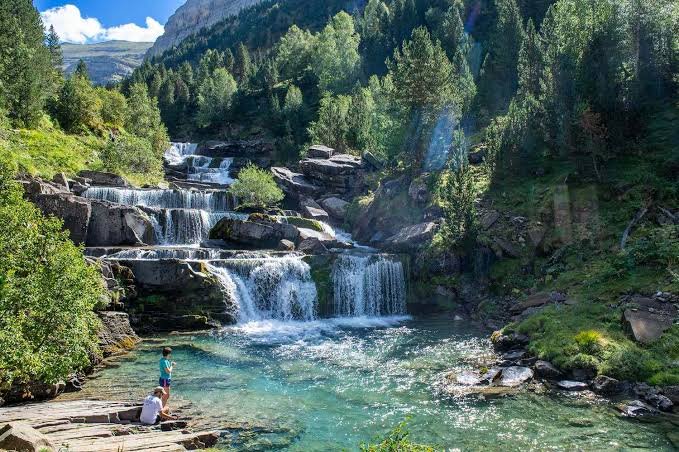
The valley is crossed by the Arazas River, which creates numerous waterfalls and pools. Hiking along the river provides visitors with opportunities to experience some of the park’s most iconic scenery.
7. Cola de Caballo Waterfall
One of the most famous natural attractions in Ordesa Valley is Cola de Caballo, meaning “Horse’s Tail.” The waterfall is located at the end of one of the park’s best-known hiking routes.
The trail to Cola de Caballo passes through forests, meadows, waterfalls, and dramatic mountain scenery. Along the way, hikers can see several beautiful cascades and viewpoints.
The waterfall is especially impressive during periods of strong snowmelt when mountain streams carry large amounts of water.
The route is popular, so travelers seeking a quieter experience may prefer to begin early in the morning or visit outside the busiest periods.
8. Arazas River
The Arazas River is one of the defining features of Ordesa Valley. It flows through the valley and feeds numerous waterfalls and cascades.
The sound of flowing water creates a peaceful atmosphere along the hiking trails. The river also supports aquatic ecosystems and contributes to the rich biodiversity of the valley.
Several viewpoints allow visitors to observe waterfalls created by the Arazas and its tributaries. During spring, melting snow can significantly increase the volume of water.
9. Waterfalls of Ordesa
Waterfalls are among the most beautiful features of the national park. Popular cascades include Arripas, La Cueva, and the spectacular waterfalls along the route toward Cola de Caballo.
Waterfalls are particularly attractive in spring and early summer when snow from higher elevations melts and feeds the rivers.
Photographers should look for viewpoints where falling water contrasts with dark forest, limestone cliffs, and green vegetation.
10. Añisclo Canyon
Añisclo Canyon is another spectacular landscape within the national park. The canyon has been carved deeply into the limestone mountains by the River Bellós.
Steep rock walls rise dramatically above the river, creating a narrow and impressive mountain environment. The area is covered with forests and contains numerous waterfalls and streams.
The canyon is very different from the broad Ordesa Valley. Its narrow walls and dramatic vertical landscape give it a wild and secluded appearance.
Road access and walking routes vary according to seasonal conditions, so visitors should check current park information before planning a trip to this part of the park.
11. Pineta Valley
The Pineta Valley is one of the most beautiful areas associated with the park. Located near Bielsa, the valley is surrounded by enormous mountain walls and provides access to high mountain routes.
The landscape includes forests, meadows, streams, waterfalls, and impressive views toward the Monte Perdido massif.
Pineta is especially attractive to hikers who want to experience a quieter side of the Pyrenees. Several routes begin in or near the valley.
12. Escuaín Valley
The Escuaín area is known for its dramatic limestone landscapes, deep gorges, cliffs, and rich wildlife.
It is also an excellent area for observing birds of prey. The steep cliffs provide nesting and soaring opportunities for several mountain bird species.
Compared with the most famous routes in Ordesa Valley, Escuaín can feel more remote and peaceful, making it attractive to visitors looking for less crowded landscapes.
13. Geology of Ordesa y Monte Perdido
The geology of Ordesa y Monte Perdido is one of its most fascinating characteristics. The park is dominated by sedimentary rocks, especially limestone, which have been shaped by tectonic forces, erosion, rivers, and glaciers.
Millions of years ago, sediments accumulated in ancient marine environments. Later geological movements lifted these rocks and contributed to the formation of the Pyrenean mountain range.
Water gradually dissolved and eroded the limestone, creating caves, cliffs, channels, gorges, and other distinctive formations.
Glacial activity also played a major role. During colder periods, glaciers moved through the valleys and carved broad U-shaped landscapes.
Today, visitors can see evidence of these geological processes almost everywhere in the park.
14. Flora of the National Park
Ordesa y Monte Perdido contains diverse plant communities because of its wide range of elevations and climates.
Lower areas contain mixed forests with species adapted to the mountain environment. Higher elevations gradually transition into coniferous forests, alpine meadows, rocky habitats, and vegetation adapted to harsh conditions.
During spring and summer, mountain flowers add color to meadows and open slopes. Alpine plants must survive cold temperatures, strong winds, intense sunlight, and short growing seasons.
Visitors should avoid picking flowers because even common-looking plants can be important parts of fragile mountain ecosystems.
15. Wildlife of Ordesa y Monte Perdido
The park provides habitat for a wide variety of wildlife. Its cliffs, forests, meadows, and high mountains support mammals, birds, reptiles, amphibians, insects, and other organisms.
One of the most impressive animals associated with the Pyrenees is the bearded vulture. This large bird is famous for its distinctive appearance and specialized feeding behavior.
Golden eagles and other birds of prey can also be seen soaring above mountain cliffs.
Visitors may encounter marmots in alpine areas. Chamois, known locally as isard, are also characteristic mountain animals.
Other wildlife includes foxes, wild boar, deer, small mammals, reptiles, and numerous bird species.
16. Bearded Vulture
The bearded vulture is one of the most spectacular birds of the Pyrenees. It has a large wingspan and is adapted to life around steep mountain cliffs.
The species has a specialized diet that includes bones. It is famous for dropping large bones onto rocks to break them into smaller pieces that can be eaten.
Seeing a bearded vulture in the wild can be one of the highlights of a visit to the national park.
17. Hiking in Ordesa y Monte Perdido
Hiking is the best way to experience the national park. The park contains routes ranging from relatively easy valley walks to demanding high-altitude mountain adventures.
Beginners can choose shorter routes through forests and valleys, while experienced hikers can attempt longer routes leading toward high mountain passes and refuges.
Weather conditions can change rapidly in the mountains. A sunny morning can become cloudy or stormy later in the day, especially at higher elevations.
Proper preparation is therefore essential even for visitors planning a short hike.
18. Ordesa Valley to Cola de Caballo
The route toward Cola de Caballo is one of the most popular hikes in the park.
Hikers generally follow the Arazas River through a beautiful valley landscape. The route passes waterfalls, forests, meadows, and impressive mountain walls.
As the trail progresses, the scenery becomes increasingly dramatic. The final destination, Cola de Caballo, provides a memorable reward for the long walk.
Depending on the route and conditions, the hike can take several hours, so visitors should allow plenty of time and carry sufficient water and food.
19. Faja de Pelay
Faja de Pelay is a famous high-level route offering spectacular views across the Ordesa Valley.
A “faja” is a narrow mountain shelf or terrace. These routes can provide extraordinary views but may involve exposure and steep terrain.
Faja de Pelay is therefore more suitable for experienced hikers who are comfortable with mountain paths and changing conditions.
20. Faja de las Flores
Faja de las Flores is one of the most dramatic high routes in the Ordesa area. It traverses a high mountain terrace beneath enormous cliffs.
The views are exceptional, but the route is not suitable for inexperienced hikers. Some sections can be exposed, and the route requires good navigation skills and appropriate weather.
Anyone considering this route should carefully check current conditions and understand the technical nature of the trail.
21. Hiking to Monte Perdido
Climbing Monte Perdido is a serious high-mountain undertaking. It requires appropriate experience, fitness, equipment, and knowledge of mountain conditions.
Depending on the season, snow and ice can create technical difficulties. Conditions near the summit can be very different from those in the valleys.
Less experienced visitors can enjoy excellent views of Monte Perdido without attempting the summit.
22. Mountain Refuges
Mountain refuges are important facilities for hikers completing longer routes. Refuges provide basic accommodation and support for people traveling through the high mountains.
Popular routes can become busy during peak seasons, so hikers should research reservation requirements and opening schedules before departure.
Visitors should never assume that a refuge will always have space, food, or emergency supplies. Proper planning remains essential.
23. Best Time to Visit
The best time to visit Ordesa y Monte Perdido depends on the activities you want to enjoy.
Spring
Spring brings melting snow, powerful waterfalls, fresh vegetation, and colorful flowers. Some high routes may still be covered with snow.
Summer
Summer is generally the busiest hiking season. Lower and middle-elevation trails are often accessible, while high mountain routes depend on conditions.
Autumn
Autumn is one of the most beautiful seasons for photography. Forests change color and the landscape becomes quieter after the summer crowds.
Winter
Winter creates a spectacular snowy landscape but also introduces serious hazards. Snow, ice, short daylight hours, and avalanche conditions can make many routes unsuitable for casual visitors.
24. Weather Conditions
Mountain weather can change quickly in Ordesa y Monte Perdido. Temperature differences between valleys and high elevations can be significant.
Rain and thunderstorms can make trails slippery. Snow can remain at high elevations well into the warmer months.
Before hiking, visitors should check the latest mountain forecast and park information. Carrying layers, waterproof clothing, sun protection, and appropriate footwear is strongly recommended.
25. How to Reach the Park
Travelers commonly reach the park by road from nearby towns and cities in northern Spain. Torla-Ordesa is one of the main access points for the Ordesa Valley.
The closest major Spanish city is Zaragoza, although the journey from Zaragoza to the mountain area takes several hours by road.
Visitors may also travel from other Pyrenean destinations, depending on their itinerary.
26. Torla-Ordesa
Torla-Ordesa is one of the most important gateways to the national park. The village has traditional stone buildings, narrow streets, mountain views, restaurants, shops, and accommodation.
Its location near the entrance to Ordesa Valley makes it a popular base for hikers.
The village itself is worth exploring. Traditional architecture and mountain scenery create a strong sense of Pyrenean character.
27. Broto
Broto is another attractive village in the surrounding region. It provides accommodation, restaurants, and access to outdoor activities.
The village is located in a scenic mountain valley and can be a useful base for exploring several parts of the Pyrenees.
28. Bielsa
Bielsa is an important settlement near the Pineta Valley. It offers services for travelers and provides access to spectacular mountain landscapes.
The surrounding area is particularly attractive to hikers, photographers, and travelers interested in the quieter side of the Pyrenees.
29. Accommodation
Accommodation options around the park include hotels, guesthouses, rural homes, campsites, mountain refuges, and apartments.
Torla-Ordesa is particularly convenient for exploring the Ordesa Valley. Broto and other nearby villages provide additional choices.
During summer and holiday periods, accommodation can become busy. Booking ahead is recommended for travelers with fixed schedules.
30. Camping
Camping can be a wonderful way to experience the Pyrenean environment, but visitors must follow local regulations.
Wild camping is not automatically permitted simply because an area is remote. Protected mountain environments require special care and specific rules may apply to camping and overnight stays.
Travelers should use authorized campsites or officially permitted areas and avoid damaging vegetation.
31. Food and Local Cuisine
The surrounding region offers traditional Aragonese and Pyrenean cuisine. Local restaurants commonly serve hearty meals suitable for mountain travelers.
Traditional dishes can include stews, grilled meats, mountain cheeses, soups, vegetables, and regional specialties.
After a long hike, a warm local meal can be an enjoyable part of the mountain experience.
32. Photography Opportunities
Ordesa y Monte Perdido is a dream destination for landscape photographers.
The combination of towering limestone cliffs, forests, waterfalls, rivers, alpine meadows, and changing weather creates countless photographic opportunities.
Early morning light can create beautiful shadows across the valleys. Late afternoon light can highlight the texture of mountain cliffs.
Autumn is particularly attractive because colorful forests contrast strongly with gray limestone walls.
33. Sunrise and Sunset
Sunrise can be spectacular in the mountains, especially when low clouds fill the valleys beneath high peaks.
Sunset creates warm light on the limestone cliffs. Photographers should always remember that mountain paths become difficult to navigate after dark.
If staying out for sunset, carry a reliable headlamp and make sure the return route is safe.
34. Family Visits
Families can enjoy many accessible areas of the park. Short walks through valleys, viewpoints, waterfalls, and village visits are suitable for many children.
However, parents should consider weather, distance, elevation, and trail conditions before choosing a route.
Young children should be supervised carefully around rivers, cliffs, and steep paths.
35. Visiting with Older Travelers
Older travelers can enjoy the park without undertaking difficult mountain hikes. Scenic drives, village visits, short valley walks, and accessible viewpoints provide excellent alternatives.
Choosing accommodation close to major attractions can reduce unnecessary travel and make the trip more comfortable.
36. Responsible Tourism
Ordesa y Monte Perdido is a protected environment, and every visitor has a role in preserving it.
- Stay on marked trails where required.
- Do not pick wildflowers.
- Do not disturb wildlife.
- Take all litter with you.
- Keep noise levels low.
- Respect local communities.
- Follow fire regulations.
- Use authorized camping areas.
- Keep dogs under appropriate control according to park regulations.
- Respect seasonal closures and protected areas.
37. Safety in the Mountains
Beautiful mountain landscapes can also be dangerous. Visitors should never underestimate the Pyrenees.
Before starting a hike, check weather conditions, route difficulty, daylight hours, and trail status.
Carry a charged phone, navigation equipment, water, food, warm clothing, rain protection, and a first-aid kit.
For difficult routes, tell someone about your itinerary and expected return time.
38. What to Pack
A suitable packing list depends on the season and route, but common essentials include:
- Strong hiking shoes or boots
- Waterproof jacket
- Warm layers
- Sun hat
- Sunglasses
- Sunscreen
- Water bottle
- High-energy snacks
- Map or GPS device
- Fully charged mobile phone
- Headlamp
- First-aid supplies
- Emergency blanket for longer routes
39. Why Ordesa Is Special
Few mountain destinations combine such dramatic geology, biodiversity, cultural heritage, and hiking opportunities in one relatively compact region.
Ordesa y Monte Perdido offers enormous cliffs and peaceful forests in the same landscape. A visitor can walk beside a quiet river in the morning and look toward snow-covered peaks later in the day.
The park also demonstrates the importance of protecting mountain ecosystems. Its landscapes provide habitat for wildlife while preserving cultural traditions that developed over centuries.
40. Ordesa for Nature Lovers
Nature lovers will find countless reasons to visit. Forest ecosystems, alpine plants, rivers, birds, mammals, and geological formations make the park an outstanding destination for natural observation.
Rather than rushing from one attraction to another, visitors can spend time observing small details: birds circling above cliffs, butterflies moving through meadows, water flowing over rocks, or changing clouds around the peaks.
41. Ordesa for Adventure Travelers
Adventure travelers can choose from hiking, mountaineering, climbing, canyoning, and other mountain activities, depending on local regulations and conditions.
High-altitude routes require greater preparation than ordinary valley walks. Appropriate technical equipment may be necessary during snow and ice seasons.
42. Ordesa for Peace and Relaxation
The park is not only for adventure. It can also be a wonderful place to slow down and enjoy nature.
Visitors can sit beside a river, explore quiet villages, enjoy mountain views, or simply walk through forests without following an ambitious itinerary.
The fresh mountain air and peaceful scenery make the region ideal for travelers looking for a break from busy cities.
43. Photography Tips
Use a wide-angle lens for large landscapes and a telephoto lens for distant peaks and wildlife.
Waterfalls often look attractive with slower shutter speeds, but photographers should use appropriate equipment and remain safely away from slippery edges.
Cloudy conditions can add atmosphere to mountain photographs. Do not assume that blue skies are always the best photographic conditions.
44. Best Viewpoints
Numerous viewpoints throughout the park offer impressive perspectives. Some overlook the Ordesa Valley, while others reveal cliffs, waterfalls, and high mountain peaks.
Higher viewpoints generally require more effort to reach, but they can provide unforgettable panoramic views.
Always follow marked trails and avoid approaching unstable cliff edges for photographs.
45. One-Day Visit
A one-day visit can provide a taste of the park, especially if you focus on one main valley.
For first-time visitors, exploring the Ordesa Valley and walking part of the route toward Cola de Caballo can be a rewarding introduction.
However, a single day is not enough to experience the entire national park.
46. Three-Day Visit
A three-day itinerary allows visitors to explore more of the park.
One day can focus on Ordesa Valley, another on Añisclo Canyon, and another on the Pineta or Escuaín areas, depending on road and trail conditions.
This approach allows travelers to experience different landscapes rather than spending the entire trip in one valley.
47. Longer Trips
A week or longer allows travelers to explore the park more slowly and combine hiking with visits to surrounding Pyrenean villages.
Longer trips are especially useful for photographers and hikers because they provide flexibility when weather conditions change.
48. Nearby Attractions
The surrounding Pyrenees contain many additional attractions. Traditional villages, mountain passes, valleys, rivers, waterfalls, and other protected areas can be included in a wider itinerary.
Travelers interested in Spanish and French Pyrenean landscapes can create a multi-destination journey around the mountain range.
49. Cultural Heritage
The mountains around Ordesa have a strong cultural identity. Traditional architecture, pastoral practices, local food, seasonal activities, and village festivals contribute to the character of the region.
Visitors should take time to explore local communities rather than treating the area only as a hiking destination.
50. Traditional Mountain Architecture
Villages around the park often feature stone houses, wooden balconies, slate roofs, and narrow streets adapted to mountain weather.
This architecture reflects centuries of adaptation to the Pyrenean environment.
51. Seasonal Changes
One of the best reasons to revisit Ordesa y Monte Perdido is that the landscape changes dramatically throughout the year.
Spring brings water and flowers. Summer brings green valleys and long hiking days. Autumn introduces brilliant forest colors. Winter transforms the high mountains into a snowy wilderness.
52. Spring Waterfalls
Spring is often an excellent period for waterfall lovers. Melting snow increases river flow and makes many cascades more powerful.
However, muddy trails and remaining snow can make some routes more difficult than they appear from valley viewpoints.
53. Autumn Colors
Autumn is one of the most visually impressive times to visit. Forests change from green to yellow, orange, and brown, creating striking contrasts with the gray mountain walls.
Cooler temperatures can also make hiking comfortable, although weather can become unpredictable.
54. Winter Mountains
Winter gives Ordesa a completely different personality. Snow covers forests and high peaks, and the landscape becomes quieter.
Winter hiking requires appropriate equipment and experience. Visitors should be especially careful about ice, avalanche hazards, and limited daylight.
55. Accessibility and Trail Difficulty
Not every trail in the park is suitable for every traveler. Some paths are gentle, while others include steep climbs, narrow ledges, exposed sections, and difficult terrain.
Always research the exact route before starting and choose a trail that matches your fitness, experience, and equipment.
56. Respecting Wildlife
Wild animals should be observed from a distance. Feeding wildlife can change natural behavior and create dangerous situations.
Binoculars are useful for observing birds and mammals without approaching them.
57. Why Hikers Love Ordesa
Hikers appreciate the park because it offers an unusual variety of landscapes. A single route can include forests, waterfalls, meadows, cliffs, and mountain views.
The scenery constantly changes, making even long walks interesting.
58. Why Families Love the Region
Families can choose gentle walks, scenic viewpoints, village visits, and nature experiences without needing to climb major peaks.
The surrounding villages also provide restaurants and accommodation suitable for family travel.
59. Why Photographers Love Ordesa
Photographers are attracted by the combination of scale and detail. Huge mountain walls provide dramatic backgrounds, while flowers, waterfalls, forests, and wildlife provide smaller subjects.
Changing weather adds another layer of visual variety.
60. Environmental Conservation
Conservation is essential because mountain ecosystems are sensitive to human pressure. Increasing tourism can affect trails, vegetation, wildlife, water systems, and local communities.
Protected-area management helps balance visitor access with environmental protection.
61. Visitor Regulations
Rules can change according to season and location. Access restrictions, transportation systems, parking arrangements, camping rules, fire regulations, and trail closures may be introduced to protect visitors and the environment.
Travelers should always check official park information before visiting.
62. Public Transport and Seasonal Access
During busy periods, access to some popular areas may be managed through shuttle or public transportation systems. These arrangements can reduce traffic and protect sensitive valleys.
Visitors should check current operating schedules before traveling because seasonal transportation policies can change.
63. Digital Navigation
GPS and hiking applications can be useful, but they should not replace traditional navigation skills.
Mountain signals can be unreliable. Carrying an offline map is a wise precaution, especially on remote routes.
64. Emergency Planning
Emergency planning is important for high mountain travel. Before departure, know the emergency number used in Spain and understand how to describe your location.
For difficult routes, consider carrying appropriate emergency equipment and informing someone about your planned route.
65. Sustainable Travel Tips
- Travel during less crowded periods when possible.
- Use public transportation where available.
- Stay in locally owned accommodation.
- Eat at local businesses.
- Carry reusable water bottles.
- Avoid single-use plastic.
- Take all waste out of the mountains.
- Respect wildlife and vegetation.
- Follow official park rules.
66. Frequently Asked Questions
Is Ordesa y Monte Perdido worth visiting?
Yes. It is one of Spain’s most spectacular mountain destinations, offering dramatic valleys, waterfalls, limestone peaks, wildlife, forests, and excellent hiking.
Where is Ordesa y Monte Perdido National Park?
It is located in the Spanish Pyrenees in the province of Huesca, Aragon, near the French border.
What is the highest mountain in the park?
Monte Perdido is the highest and most famous summit associated with the park, reaching approximately 3,355 meters.
Can beginners visit the park?
Yes. Beginners can enjoy easier valley walks and viewpoints. More demanding routes require greater experience.
How long should I spend in Ordesa?
Two to four days is a good starting point for experiencing several major areas, while longer stays allow deeper exploration.
What is the most famous waterfall?
Cola de Caballo is one of the park’s best-known waterfalls and a popular hiking destination.
Can I see wildlife?
Yes. The park contains many birds and mammals, including chamois, marmots, birds of prey, and other Pyrenean species.
Is Ordesa suitable for families?
Yes. Families can choose shorter walks and scenic areas, but children should be supervised around rivers, steep slopes, and cliffs.
Can I camp anywhere in the park?
No. Camping regulations apply in protected areas. Visitors should use authorized facilities and follow current local rules.
Can I climb Monte Perdido?
Experienced mountaineers can attempt the summit under suitable conditions, but it is a serious high-mountain activity and requires appropriate skills and equipment.
What should I wear?
Wear comfortable hiking footwear and layered clothing. Carry waterproof protection and extra warm clothing because mountain weather can change quickly.
67. Final Thoughts
Ordesa y Monte Perdido National Park is a spectacular destination where mountains, forests, rivers, waterfalls, wildlife, geology, and traditional culture come together. Its dramatic limestone landscapes make it one of the most memorable natural areas in Spain and one of the great mountain destinations of the Pyrenees.
From the magnificent Ordesa Valley and Cola de Caballo waterfall to the deep Añisclo Canyon, peaceful Pineta Valley, dramatic Escuaín landscapes, and towering Monte Perdido massif, the park offers experiences for many types of travelers.
Hikers can explore challenging mountain trails, families can enjoy easier walks, photographers can capture extraordinary scenery, wildlife enthusiasts can search for birds and mammals, and travelers seeking peace can simply enjoy the forests and valleys.
The most important thing is to visit responsibly. Protecting the landscape, respecting wildlife, following park regulations, and supporting local communities help ensure that future generations can experience the same extraordinary beauty.
Whether you visit for a single day or spend a week exploring the Pyrenees, Ordesa y Monte Perdido has the power to leave a lasting impression. Its combination of natural beauty, geological history, cultural heritage, and outdoor adventure makes it one of the most remarkable protected landscapes in Europe.
68. SEO Keywords
Ordesa y Monte Perdido National Park, Ordesa National Park Spain, Monte Perdido, Ordesa Valley, Spanish Pyrenees, Pyrenees National Park, Cola de Caballo waterfall, Ordesa hiking, Ordesa travel guide, hiking in Ordesa, Spain national parks, Añisclo Canyon, Pineta Valley, Escuaín Valley, Monte Perdido hiking, Ordesa wildlife, Ordesa waterfalls, best time to visit Ordesa, Ordesa travel tips, Spanish mountain destinations.
69. Conclusion
Ordesa y Monte Perdido National Park is more than a beautiful mountain destination. It is a living landscape shaped by geology, climate, wildlife, water, glaciers, and generations of human interaction. Its spectacular cliffs and valleys demonstrate the power of nature, while its villages and traditions show the deep connection between people and the Pyrenees.
For anyone planning a nature-focused trip to Spain, this national park deserves a place near the top of the list. With careful planning, suitable equipment, respect for the environment, and enough time to slow down and appreciate the scenery, a visit to Ordesa y Monte Perdido can become one of the most memorable journeys in the Spanish mountains.